Image 1 of 3
 Image 2 of 3
 Image 3 of 3
In private collection.
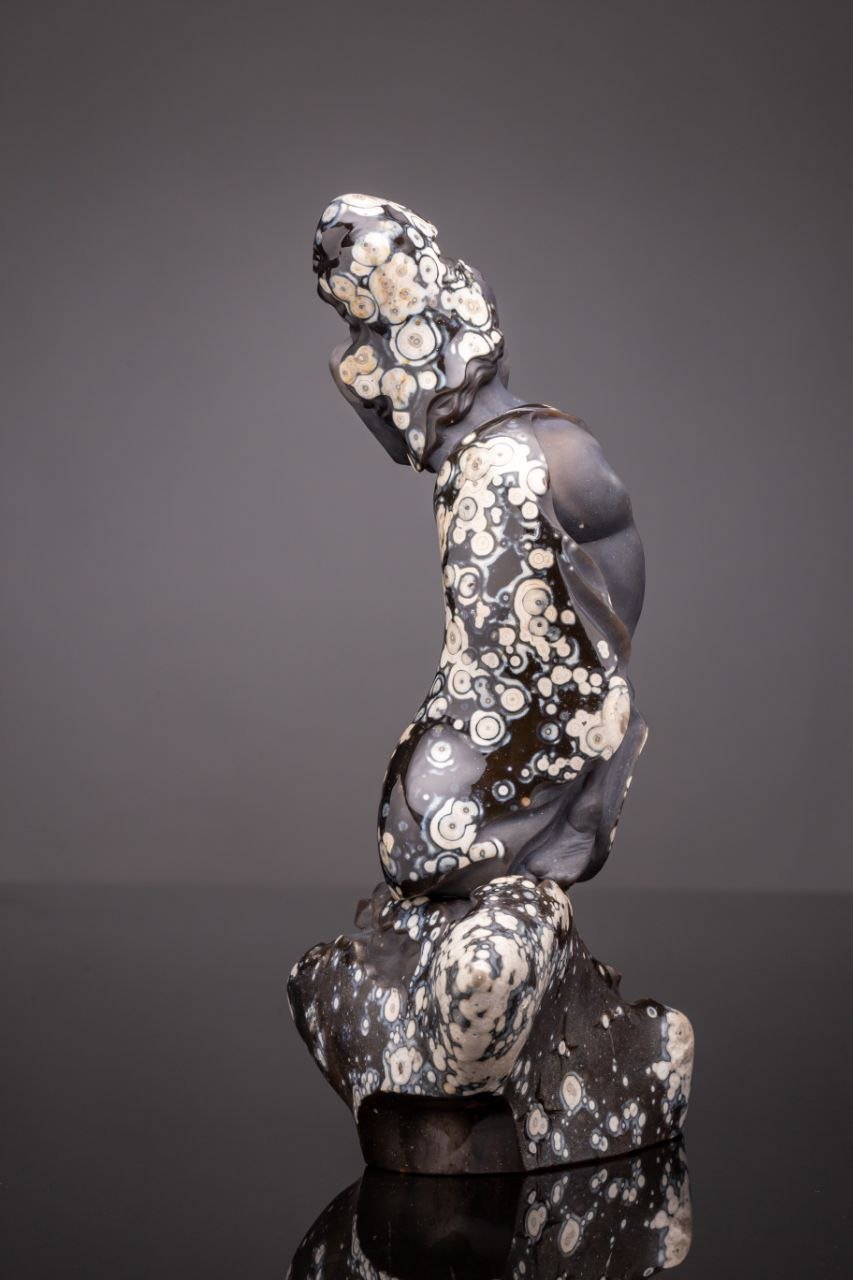
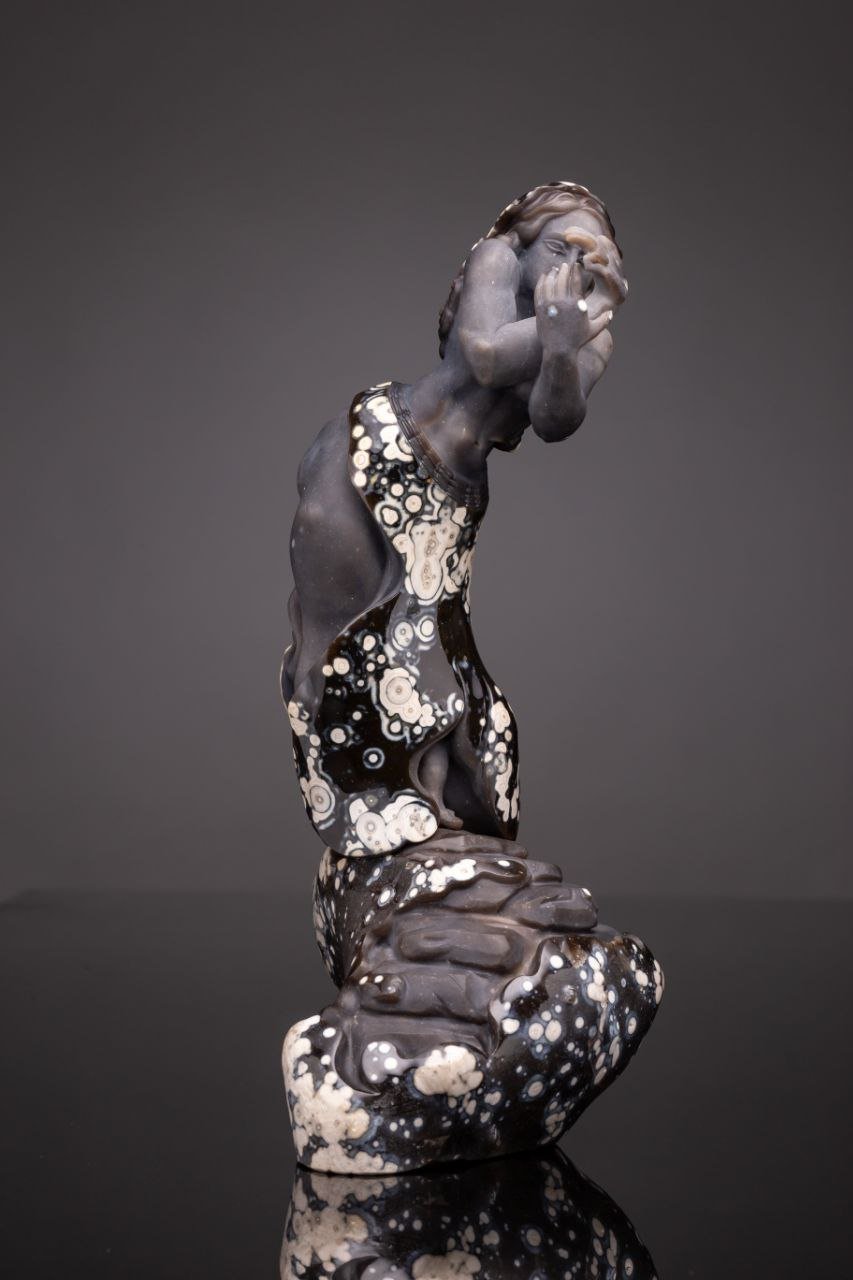
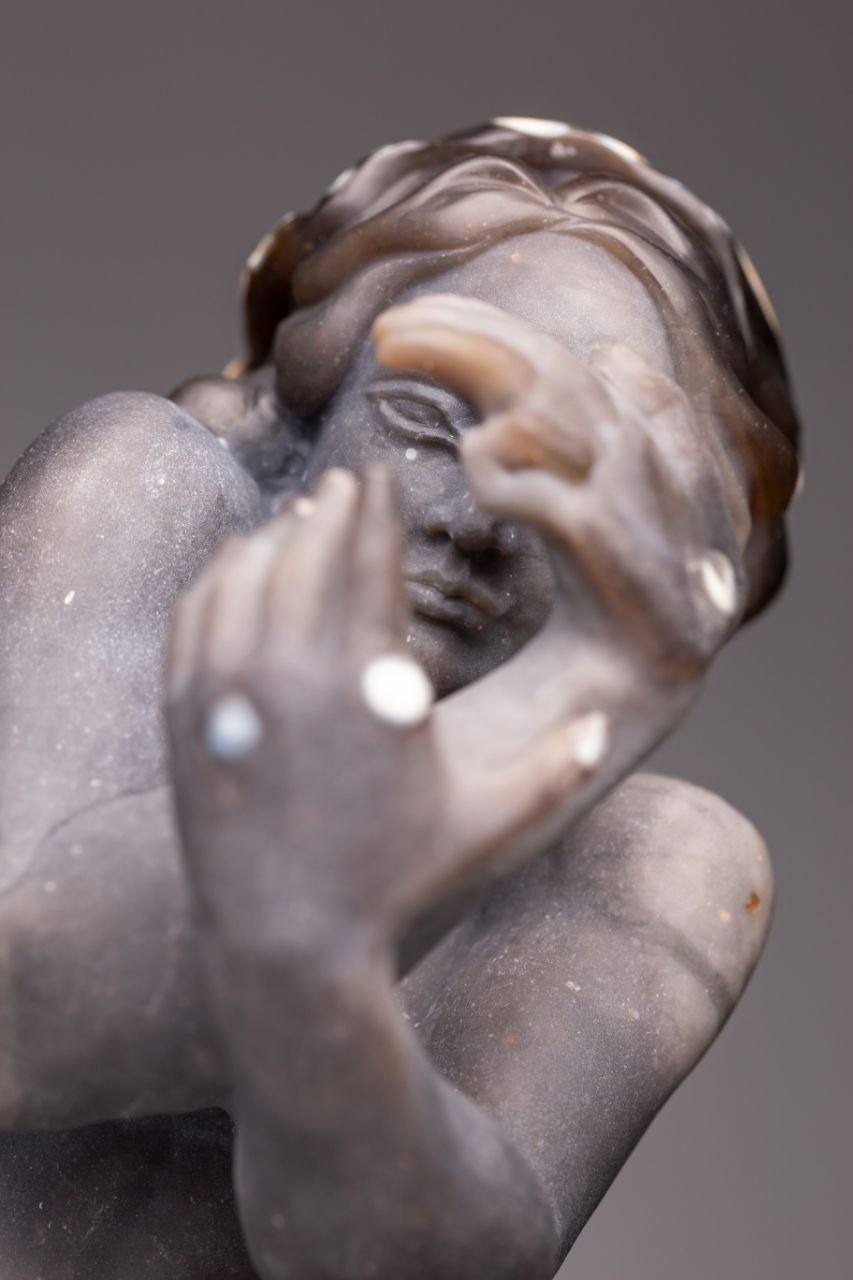
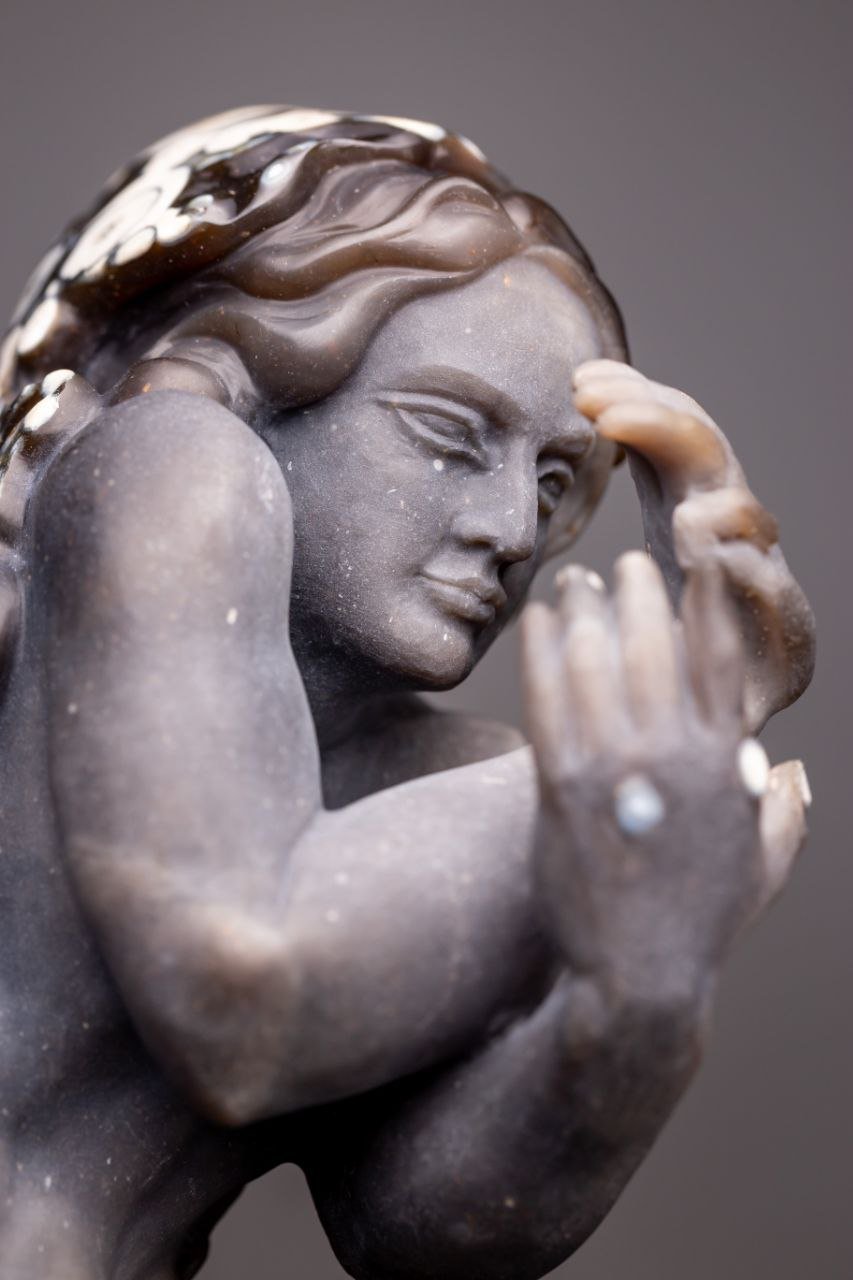
Ozymandias is carved on an elongated single crystal of transparent stone: a high-relief image of a man's head with a matte face and the attributes of the supreme ruler of Egypt, a striped claft headdress crowned with a voluminous uraeus serpent and a false cylindrical beard with transverse stripes. The surface around the face is covered with faceted rock fragments, with a fragment of vegetation at the side and a vertical layering of planes with a wood texture in the upper part.
Complex in design and in execution, the work brings together the natural, timeless character of the stone, about 4 kg of it, and a man-made image that seems to have arisen from eternity. The artist names the sonnet of the same name by the English poet P. Shelley, written in 1817, as the starting point for the work; it is given here in the translation by K. Balmont:
I met a traveller; he came from distant countries
And he said to me: far away, where eternity guards
Desert silence, among the deep sands
A fragment of a broken statue lies.
From the half-erased features, an arrogant flame shines through,
The desire to force the whole world to serve itself;
An experienced sculptor invested in a soulless stone
Those passions that could survive centuries.
And the fragment of the statue kept the words:
I am Ozymandias, I am the mighty king of kings!
Look at my great deeds
Masters of all times, all countries and all seas!
There is nothing around. Deep silence.
The desert is dead. And the skies above it.
Ozymandias is the ancient Greek name of the Egyptian pharaoh Ramses II (1279–1213 BC).
Materials: rock crystal
Technique: carving
Place: St Petersburg
Dimensions: height 28 cm
Weight: about 4 kg
Year: 2021
Artist: G. Pylin
From the collection of the Maximilian Art Foundation.
In private collection.
Ozymandias is carved on an elongated single crystal of transparent stone: a high-relief image of a man's head with a matte face and the attributes of the supreme ruler of Egypt, a striped claft headdress crowned with a voluminous uraeus serpent and a false cylindrical beard with transverse stripes. The surface around the face is covered with faceted rock fragments, with a fragment of vegetation at the side and a vertical layering of planes with a wood texture in the upper part.
Complex in design and in execution, the work brings together the natural, timeless character of the stone, about 4 kg of it, and a man-made image that seems to have arisen from eternity. The artist names the sonnet of the same name by the English poet P. Shelley, written in 1817, as the starting point for the work; it is given here in the translation by K. Balmont:
I met a traveller; he came from distant countries
And he said to me: far away, where eternity guards
Desert silence, among the deep sands
A fragment of a broken statue lies.
From the half-erased features, an arrogant flame shines through,
The desire to force the whole world to serve itself;
An experienced sculptor invested in a soulless stone
Those passions that could survive centuries.
And the fragment of the statue kept the words:
I am Ozymandias, I am the mighty king of kings!
Look at my great deeds
Masters of all times, all countries and all seas!
There is nothing around. Deep silence.
The desert is dead. And the skies above it.
Ozymandias is the ancient Greek name of the Egyptian pharaoh Ramses II (1279–1213 BC).
Materials: rock crystal
Technique: carving
Place: St Petersburg
Dimensions: height 28 cm
Weight: about 4 kg
Year: 2021
Artist: G. Pylin
From the collection of the Maximilian Art Foundation.